Non classé
⚛ Hydrogen Micromobility’s First Real Win
8 April, 2026
In 2023, Chinese fire departments logged 21,000 e-bike fire incidents due to lithium-ion batteries, a 17.4% year-on-year increase, meaning that the structural demand driver for safe hydrogen alternatives was real, but the product wasn’t ready.
The hydrogen bike narrative in China has not been a smooth one though. When MIT Technology Review covered the sector in August 2024, the headline was unambiguous: “Hydrogen bikes are struggling to gain traction in China.” More than a year into its trial in suburban Shanghai, Youon Technology‘s hydrogen fleet had been recalled amid widespread complaints about technical failures.
Eighteen months later, the picture has shifted materially. Not because the incumbents fixed their issues, but because a startup from Chengdu’s Xindu district took a fundamentally different technical path — and backed it with a deployment scale that changes the terms of debate.
The Numbers That Matter
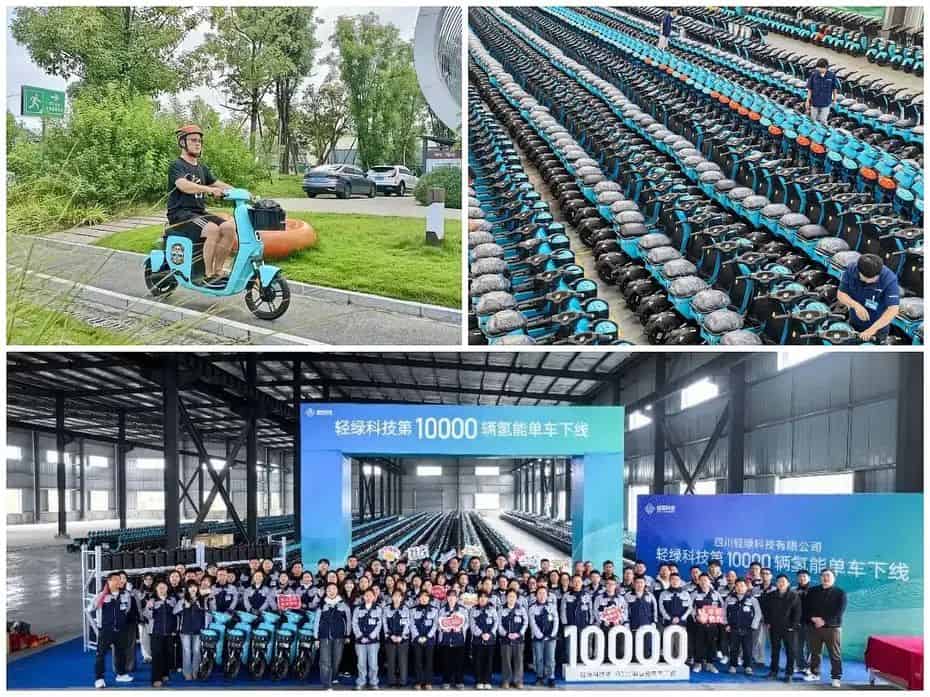
Since its commercial launch in August 2025, Qinglv Technology has deployed 11,000 hydrogen-powered shared bikes in Xindu, attracting over 550,000 registered users and logging more than 3.5 million rides. By any operational benchmark — fleet density, registered user base, ride volume — this is a functioning shared mobility service running at meaningful commercial scale on an unproven propulsion technology.
For context: prior to this phase, Qinglv had completed a 500-unit pilot, followed by a 3,000-unit expansion, making Xindu the first location in China to achieve large-scale implementation of hydrogen-powered transport. The progression from 500 to 11,000 units within a single operating year, with no apparent recall and continued expansion underway, is itself a signal worth noting.
Pricing is structurally competitive: 2.5 yuan for the first 10 minutes, then 1 yuan per additional 5 minutes — broadly in line with conventional e-bike share tariffs in tier-1 Chinese cities.
The Technical Differentiation: Why This Deployment Works
The failure mode of earlier hydrogen bike deployments — Youon’s Lingang recall being the most documented — traced back to a combination of underwhelming rider experience and operational brittleness. The bikes were heavy, assist was inconsistent, and the constraint of returning to designated docking points for tank replenishment created exactly the kind of friction that kills adoption in free-floating or semi-docked models.
Qinglv’s approach addresses these pain points at the hardware level, not through operational workarounds.
Solid-state hydrogen storage at 2 MPa. This is the pivotal technological choice. Rather than conventional high-pressure tanks operating at 35–70 MPa, the “hydrogen pony” uses solid-state technology combining hydrogen with a metal powder alloy, keeping internal pressure at just 2 MPa. Even in the event of a leak, the release would be slow and manageable. From an operator liability standpoint, this is not a marginal improvement — it removes the primary regulatory and insurance barrier to deploying hydrogen vehicles in unattended, public-access environments at scale.
The science behind this is well-established in the research literature. Metal hydride storage achieves volumetric hydrogen densities of 100–130 kg/m³ — roughly three times that of 70 MPa gaseous hydrogen — while operating at near-ambient conditions, with solid-state materials reusable for service lives exceeding 20 years. The challenge has always been translating this into a product format suitable for consumer micromobility. Qinglv’s 100g cartridge appears to be the first implementation at this scale that has done so reliably.
~100 km range on 100g of hydrogen. Each bike carries 100 grams of hydrogen, delivering a range of approximately 100 kilometres — roughly twice that of a conventional shared e-bike. For fleet operators, this translates directly into fewer rebalancing runs per vehicle per day, higher asset utilization rates, and more predictable revenue per unit. The operational cost implications compound significantly across a fleet of 10,000+ units.
Cold-weather resilience. Hydrogen fuel cells are barely affected by temperature changes, whereas lithium batteries lose capacity rapidly in cold conditions. This is a structural operational advantage in any market with seasonal variation — and a significant factor in Qinglv’s ambitions to expand into northern Chinese cities including Shenyang and Jinan.
Qinglv Leads the Pack with a Focus on Shared Mobility
Qinglv is not operating in a vacuum. Youon, China’s most established hydrogen bike manufacturer with over 1 million private bikes across 300 cities, has been investing in hydrogen since 2018 and now has four shared models deployed across six cities. In early 2025, Hello, China’s largest bike-sharing operator, acquired a majority stake in Youon — a consolidation move that signals institutional conviction in the category, regardless of the earlier execution struggles.
What distinguishes Qinglv is the combination of a cleaner storage architecture and an operator-first deployment strategy. Youon’s early deployments prioritized individual sales to municipalities; Qinglv built a vertically integrated shared service from the outset, owning the rider experience and the operational data. That distinction matters enormously when iterating on fleet performance.
The Scale-Up Plan and the Cost Curve
The company currently produces at 30,000 units annual capacity, and is constructing a new facility in Xindu dedicated to manufacturing small-power hydrogen fuel cell systems specifically for hydrogen bikes, with a targeted annual capacity of 300,000 units, scheduled for production by end of 2025.
The economics are contingent on this ramp. Co-founder Yang Hao has stated that at 300,000 units annual output, per-unit costs reach parity with lithium battery-powered bikes. This is the credible path to removing the one remaining structural barrier to widespread operator adoption — a path that Qinglv is engineering deliberately rather than waiting for market conditions to shift.
Geographically, the expansion pipeline includes Hangzhou, Jinan, Sanya, Shenyang, and Ganzhou domestically, plus confirmed orders for 50,000 units from overseas markets spanning the Middle East, Europe, the United States, and Southeast Asia. International deployments will require product localization — regulatory compliance, ergonomic adjustments, refuelling ecosystem development — but the export order book at this stage of maturity is unusual.
What Operators and Cities Should Take From This
The Qinglv deployment resolves several questions that have been theoretically debated in the hydrogen micromobility space.
Solid-state low-pressure storage is deployable in unattended shared environments. The Xindu fleet has demonstrated this at 11,000 units across a real urban district over multiple months without a recall event.
The range advantage is operationally meaningful, not just a spec sheet number. At ~100 km per refill versus ~50 km for a standard shared e-bike, hydrogen bikes require roughly half the refuelling interventions per vehicle-day — a direct reduction in one of the most labour-intensive and cost-sensitive elements of shared fleet operations.
The regulatory access advantage is structural. Multiple major Chinese cities have restricted or banned lithium battery-powered shared bikes due to fire risk. Hydrogen bikes operating at 2 MPa face no equivalent restriction and have actively been welcomed by municipal governments as a compliant alternative. In markets where the regulatory headwind against lithium is intensifying — and that trend extends well beyond China — this is a durable competitive moat.
Yang Hao has been consistent in framing the technology as complementary rather than substitutive: “There is room for both — lithium and hydrogen will coexist and complement each other.” That is the right positioning for now. The more operationally relevant question for shared mobility operators is not whether hydrogen replaces lithium, but in which specific fleet segments and geographies the operational economics of hydrogen already make more sense. The Chengdu data is beginning to answer that question.