Cities, General
🌮 World Cup 2026: How Segway and Whoosh Are Redefining Urban Mobility in Mexico
29 June, 2026
The 2026 World Cup isn’t only being played on the pitch. Between stadiums and fan zones, across the streets of Mexico City and Monterrey, another competition is quietly unfolding — one for urban mobility. And in that race, Segway and shared mobility operator Whoosh appear to have taken a decisive lead.
An Initiative Born from a Simple Observation
Hosting a World Cup means exposing a city to unprecedented pressure on its transport infrastructure. Millions of supporters, dozens of matches, and ridership peaks that traditional public transit simply cannot absorb on its own. That’s the gap Segway and Whoosh chose to address, launching a free e-scooter ride campaign across Mexico for the duration of the tournament.
The mechanic is straightforward: users enter the promo code RIDEWITHSEGWAY in the Whoosh app and unlock a complimentary ride — including scooter unlocking and up to 20 minutes of travel. In total, Segway and Whoosh have made 6,250 free rides available to fans and residents, offered in limited daily quantities but targeted with precision.
Numbers That Speak for Themselves
The campaign kicked off in Mexico City on June 10th, with operations extending to Monterrey on June 29th, running through July 5. And the early data from the first weeks of the campaign tells a compelling story.
A fleet of 1,000 Whoosh e-scooters was deployed strategically to connect the key nodes of urban mobility: metro stations, stadiums, fan zones, and bus terminals. The goal wasn’t to scatter vehicles across the city, but to build genuine service continuity between the existing links of the transport network.
The results back that up. Thousands of free rides have already been redeemed — and 89% of those riders were first-time users. That figure might be the most revealing of the entire campaign. It means that the free-ride offer worked as a genuine entry point into micromobility for people who had never tried it before. Lower the financial barrier, even marginally, and you trigger the first experience — and often, the conversion.
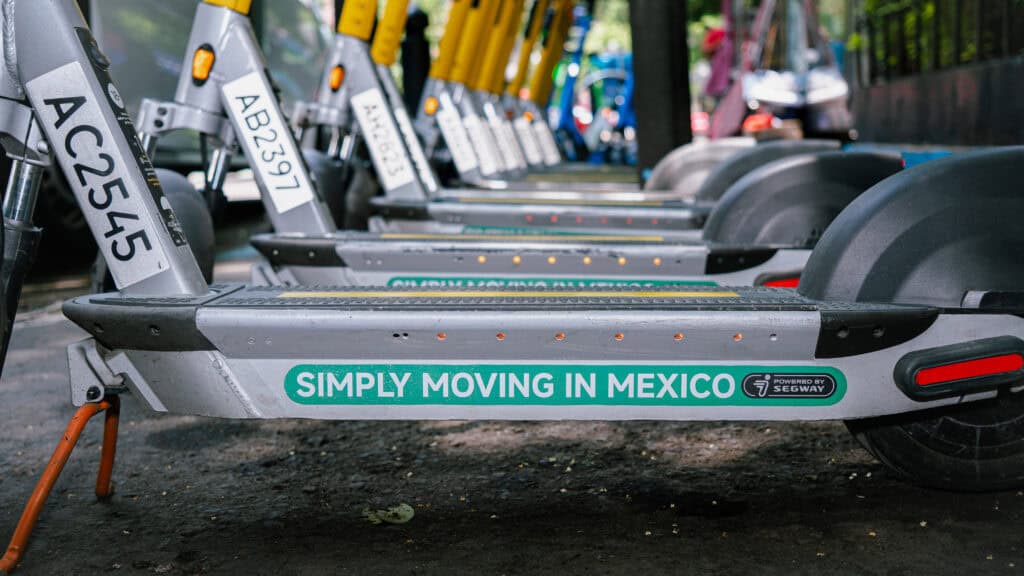
Another striking figure is the average trip duration of 25 minutes, with over 36,000 total promotional minutes logged. Twenty-five minutes isn’t a leisure ride. That’s a real urban trip. The data confirms that users didn’t simply test the scooter out of curiosity — they adopted it as a genuine transport tool to solve real mobility challenges on match days.
Micromobility Put to the Test
What makes this initiative particularly interesting from an industry perspective is that it goes well beyond event marketing. It documents, in real conditions and at scale, how shared micromobility can integrate into a transport ecosystem under pressure.
Major sporting events are exceptional testing grounds: flows are massive, compressed in time, and any failure in the system becomes immediately visible. Segway and Whoosh didn’t shy away from that complexity — they made it their proving ground.
That’s exactly what cities are looking for. Not promises of seamless mobility, but evidence. Not vehicles positioned for photo opportunities, but usage data showing that people actually changed their travel behavior because of the service deployed.
A Model Worth Replicating
Beyond Mexico and the World Cup, this partnership lays the groundwork for a replicable model. Segway, a global leader in mobility solutions, brings the hardware dimension and industrial credibility. Whoosh, as a ground-level operator, brings local usage expertise, operating licenses, and the capacity to manage a fleet in real time.
This manufacturer-operator complementarity is precisely the structure that allows shared micromobility to scale. It avoids the two classic pitfalls of the sector: hardware without service, and service without hardware reliability.
For cities that will host the Olympics, international summits, or other global events in the years ahead, the Mexican experience will be a valuable reference. Micromobility is no longer an urban accessory — it is becoming a structural component of the response to mobility peaks. Segway and Whoosh are proving it, one 25-minute ride at a time.
This article was written as part of a partnership with Segway.